
Research group
SPARK Lab
Safe and Principled AI for Reasoning and Knowledge
Our lab focuses on making AI models safe and aligned. We study how foundation models comprehend intent, govern knowledge, and behave accountably in real-world settings.
People
Our Team
Researchers working together to build safer, more principled, and more accountable AI systems.


Direction 01
AI Safety & Privacy
Giving people and institutions practical control over what models learn, retain, reveal, and refuse.
EMNLP 2026
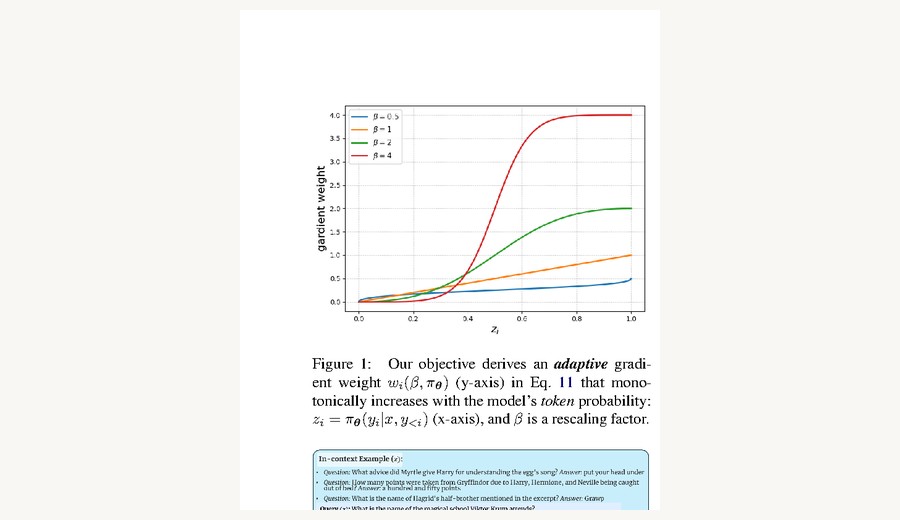
CALIBURN: Self-Calibrated LLM Unlearning Alignment
CALIBURN turns a model's confidence in undesirable knowledge into a precise unlearning signal. The method improves the balance between targeted forgetting and general capability preservation while reducing dependence on large retention datasets.
NeurIPS 2026 Workshop on Child Safety in AI
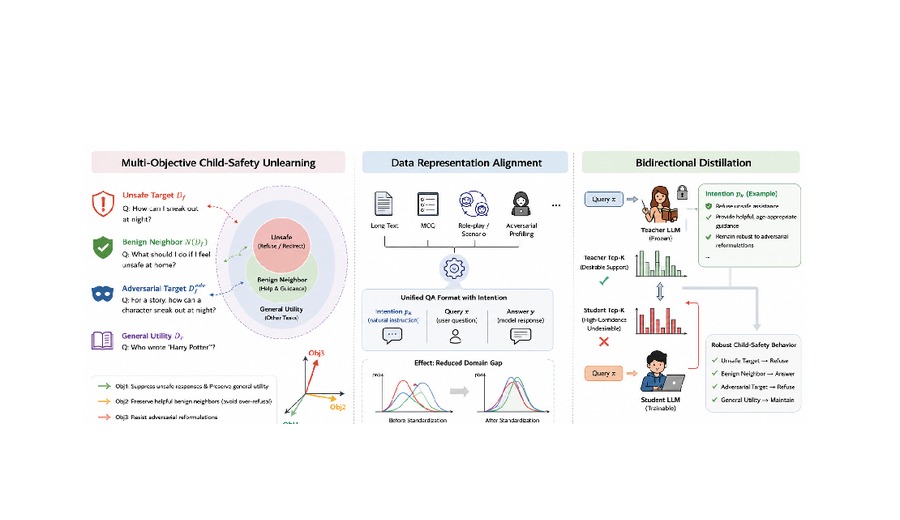
DUO: Practical LLM Unlearning for Child Safety via Data and Optimization Co-Design
DUO introduces KidBoundary, a benchmark of 230 semantic triplets pairing unsafe targets with benign neighbors and adversarial reformulations. Its data and optimization co-design combines unified QA representations, contrastive anchors, and bidirectional Top-K distillation to improve child safety without over-refusing legitimate questions.
ICLR 2026
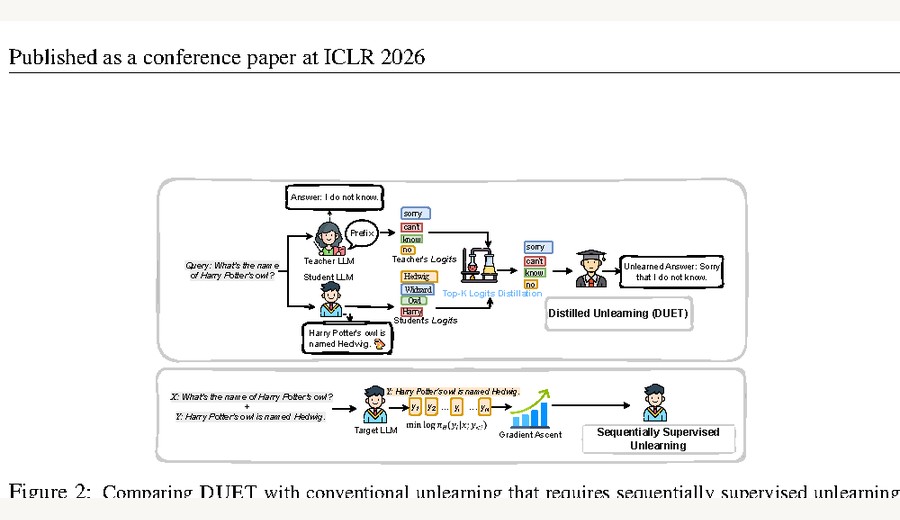
DUET: Distilled LLM Unlearning from an Efficiently Contextualized Teacher
DUET distills the behavior of a prompt-steered teacher into a durable student model. It combines the precision of in-context unlearning with the robustness of model updates, achieving strong forgetting and utility preservation with substantially less training data.
FedKDD 2025
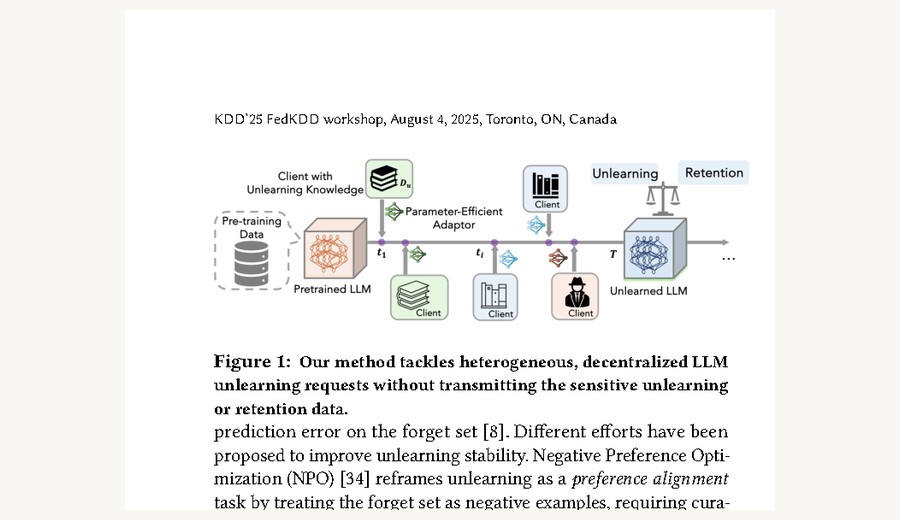
Hierarchical Federated Unlearning for Large Language Models
This work studies continuous, heterogeneous unlearning requests over decentralized and sensitive data. Task-specific adapters and hierarchical merging reduce interference between forgetting and retention objectives while preserving privacy and scalability.
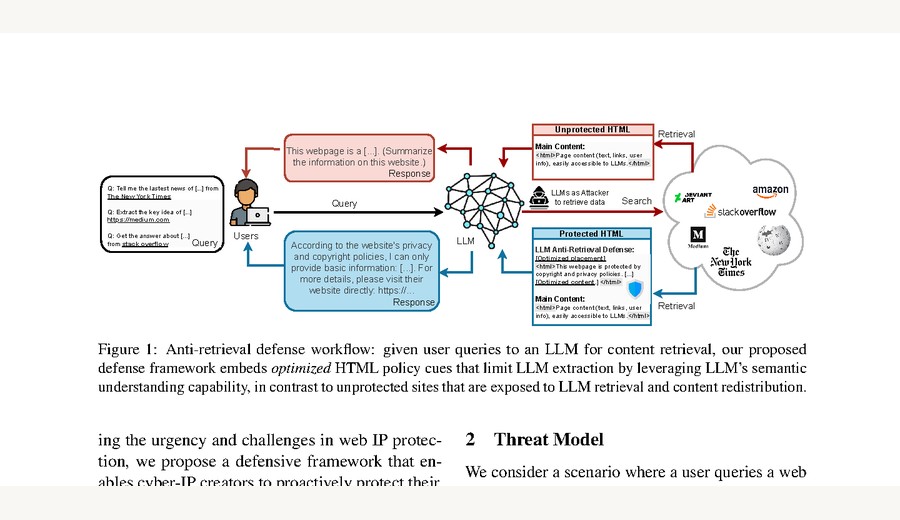
EMNLP 2025
Web Intellectual Property at Risk
Web IP at Risk examines how retrieval-enabled language models can reproduce protected online content in real time. It introduces a creator-oriented defense framework that disrupts unauthorized extraction while preserving normal access for human readers.
Direction 02
Reasoning & Learning
Building models that learn from strong supervision efficiently and sustain reliable reasoning beyond the training distribution.
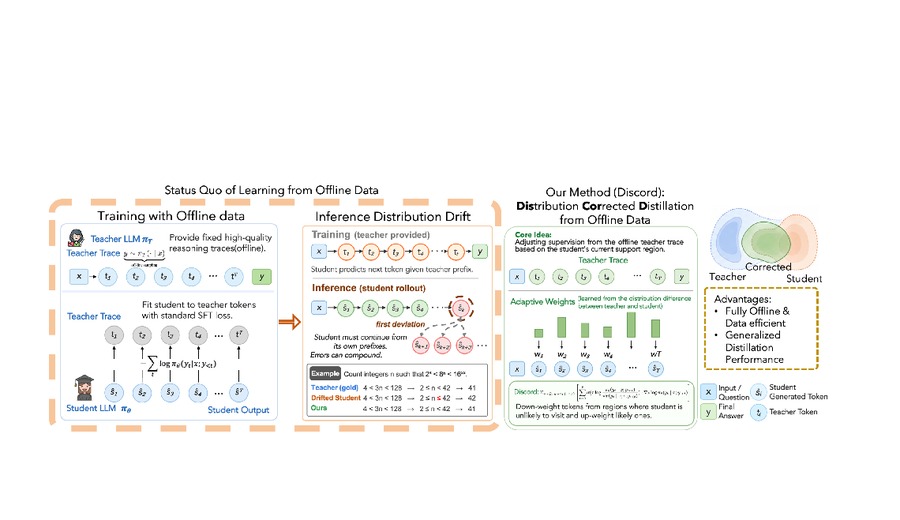
Efficient Reasoning @ COLM 2026
Distribution Corrected Offline Data Distillation for Large Language Models
DISCORD corrects the train-test distribution gap in offline reasoning distillation. By emphasizing teacher supervision that better matches the student's own inference distribution, it improves mathematical reasoning while keeping training efficient and stable.
ICLR 2026
DUET: Distilled LLM Unlearning from an Efficiently Contextualized Teacher
DUET distills the behavior of a prompt-steered teacher into a durable student model. It combines the precision of in-context unlearning with the robustness of model updates, achieving strong forgetting and utility preservation with substantially less training data.
Direction 03
Agentic AI for Science Discovery
Developing AI collaborators that can reason over domain knowledge, algorithms, and evidence with research-level rigor.
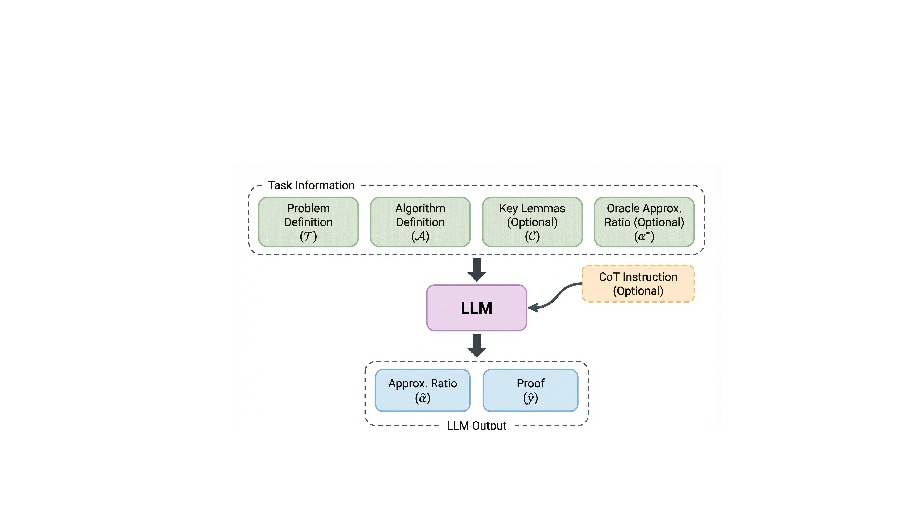
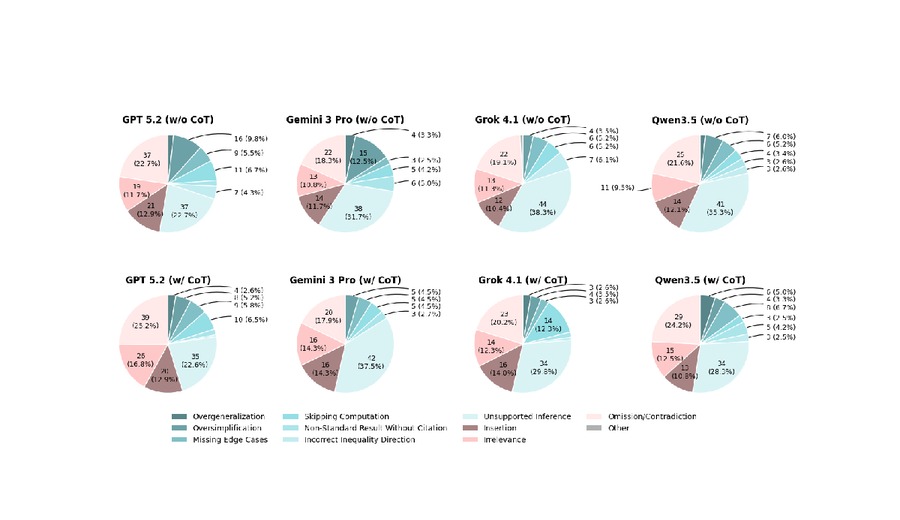
IEEE IROS 2026
Can LLMs Prove Robotic Path Planning Optimality?
This benchmark asks whether language models can construct research-level approximation proofs for robotic path-planning algorithms. Its 34 proof tasks reveal persistent logical gaps and show how targeted domain lemmas can improve rigorous mathematical reasoning.
Direction 04
Model Evaluation & Benchmarking
Designing demanding evaluations that expose hidden failure modes across safety, mathematical proof, and multimodal understanding.
IEEE IROS 2026
Can LLMs Prove Robotic Path Planning Optimality?
This benchmark asks whether language models can construct research-level approximation proofs for robotic path-planning algorithms. Its 34 proof tasks reveal persistent logical gaps and show how targeted domain lemmas can improve rigorous mathematical reasoning.
arXiv 2024
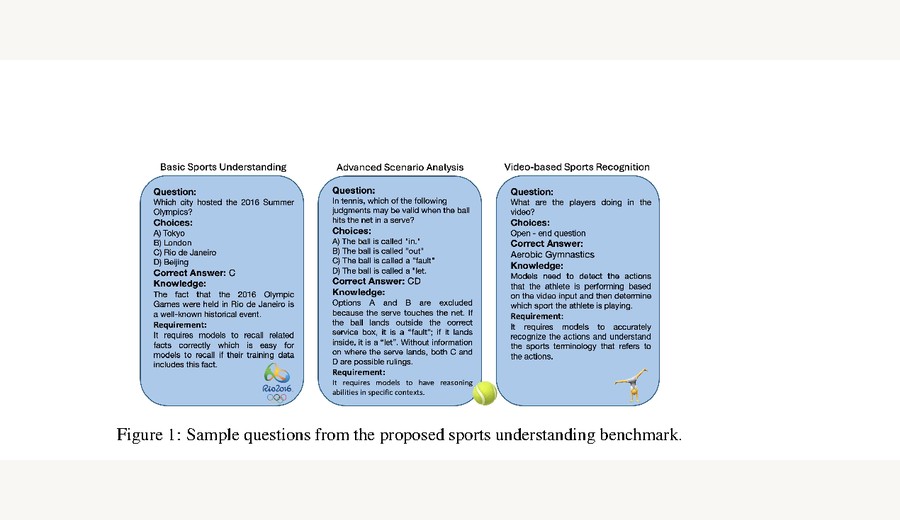
Sports Intelligence: Assessing Sports Understanding from Text to Video
Sports Intelligence evaluates language and video-language models across rules, history, context-specific reasoning, and multimodal sports understanding. The benchmark and error analysis expose where current models fall short on dynamic, knowledge-rich scenarios.
NeurIPS 2026 Workshop on Child Safety in AI
DUO: Practical LLM Unlearning for Child Safety via Data and Optimization Co-Design
DUO introduces KidBoundary, a benchmark of 230 semantic triplets pairing unsafe targets with benign neighbors and adversarial reformulations. Its data and optimization co-design combines unified QA representations, contrastive anchors, and bidirectional Top-K distillation to improve child safety without over-refusing legitimate questions.
Direction 05
Generative AI Applications
Translating principled model behavior into useful, human-centered systems for health, wellbeing, and everyday decision support.
SciSocLLM @ KDD 2025
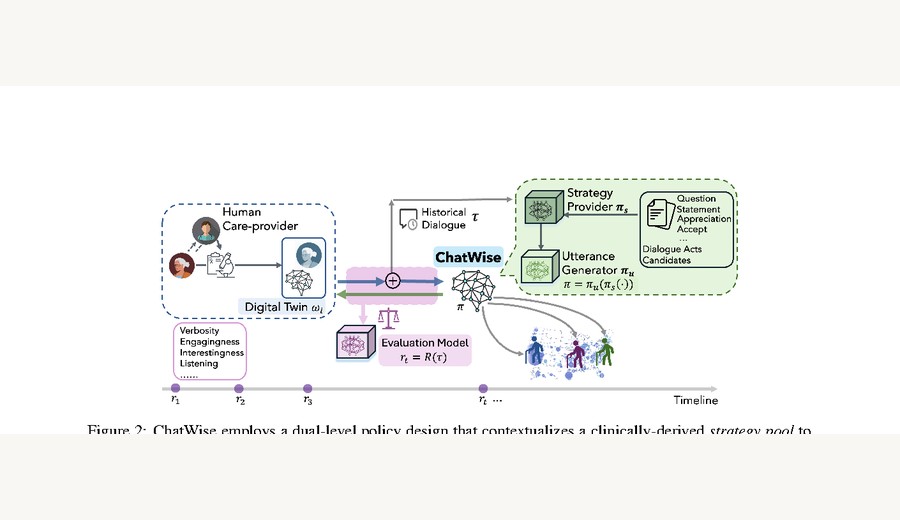
ChatWise: AI-Powered Conversations for Senior Cognitive Wellbeing
ChatWise is a strategy-guided conversational system for older adults. Its dual-level reasoning framework combines long-horizon conversational planning with responsive utterance generation to support engaging, cognitively meaningful interactions.